Category Archives: nutrition

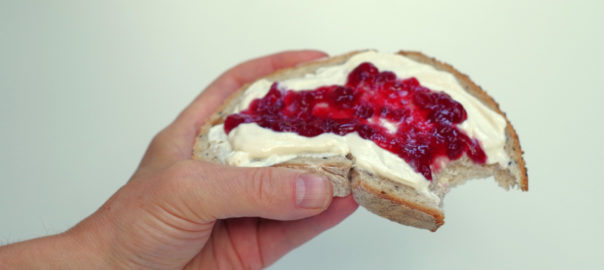
Picture of bread with vegan cheese spread

Fresh vegan cheese

Yoga Kitchen – Simple, healthy and plant-based

The perfect and tasty alternative

Fresh white cheese, also known as flat cheese in Flemish and cottage cheese, used to be a favourite on my breakfast table. Fortunately, today I can make a quick vegan version of this in no time.

There are some vegetable cottage cheese substitutes available on the market. The organic versions, from the brand Provamel among others, are hard to find in organic stores and organic supermarkets, which still give high priority to (organic) animal dairy products. The classic cottage cheese substitute from Alpro in the ordinary supermarket (Alpro Greek Style) in its “natural version” contains no less than 14 ingredients, including sugar (!) and a whole bunch of preservatives to guarantee the thing a long life on the shop shelves. Whenever I eat the latter, my palate tends to react violently against it.

The good news: with silken tofu you can make vegan “flat” cheese in no time with just 3 ingredients!

What you need

  • One packet of silken tofu
  • The juice of half a or a whole lemon (to taste)
  • A pinch of sea salt or Himalayan salt (to taste)

Silken tofu is commonly found in 400g (The Hobbit or Taifun) or small 300g (Clearspring) brick packs. The protein content varies quite markedly. So this is not a recipe with very precise quantities. I invite you to experiment according to taste and preference.

This is how you do it

  • Put the silken tofu in a food processor after you drain or press out the excess water
  • Add the salt and lemon juice
  • Mix in the food processor until you get a creamy consistency
  • Taste and if necessary add some more lemon or salt

This vegan fresh cheese will keep for about 5 days in the fridge.
It can further serve as a starting point for all kinds of delicious variations

Tip for the texture

  • If you want a fairly smooth and creamy texture, blend this white vegan cheese in a food processor as described above.
  • However, for a firmer, slightly lumpy texture, similar to fresh cottage cheese, you’ll need to do things differently. First, leave the silken tofu to drain in a fine sieve for a little longer. Then, add the lemon juice and salt, and mix more roughly with a fork.

How to make a savoury dip of this vegan cheese

  • Add a tablespoon of miso to the mixture
  • Add a tablespoon of sesame oil and mix well
  • You can finish off with extra fresh herbs or spices to taste

How to make a chocolate spread

  • Add a tablespoon of unsweetened (preferably raw) cocoa powder
  • Sweeten with one or two tablespoons of agave syrup or other suitable wholefood sweetener

How to make a delicious plant-based tzatziki

Read the recipe for vegan tzatziki here (link) and see how easy it is to make a delicious fresh summer side dish with this vegan fresh cheese as a base, for a salad buffet or as a spread.

Sweet treats with silken tofu

Silken tofu is also a perfect base for all kinds of sweet desserts. Read more here.

Why not use animal dairy products?

The current methods of producing animal dairy products are very harmful to the environment and wasteful of resources and raw materials. Moreover, they are based on the merciless exploitation of animals. Newborn calves, goats or buffaloes are immediately taken from their mothers because the milk is stolen for human consumption. It is a painful cycle of forced insemination, forced childbirth and repeated severing of the maternal bond that the mother animals are forced to go through again and again. Until, after repeated pregnancies and giving thousands and thousands of litres of milk, they are finally sent to the slaughterhouse. I find that incredibly cruel and out of keeping with our current state of civilisation.
In addition, milk is presented as much healthier than it really is. The fact that adults still drink the mother’s milk of another species is completely absurd.

What could the dairy of the future look like?

Food technology is evolving at a rapid pace, and it looks as if the entire classical dairy sector is going to disappear completely. Anyone who wants to eat animal cheeses and other derived dairy products in the future can be sure that in the near future they will be made by fermentation processes in tanks. The starting point will be a limited quantity of animal stem cells or substances. The animal itself will finally be freed from the slavery of dairy production and human exploitation.
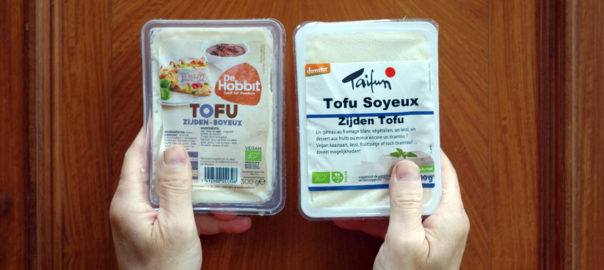
Picture of two brands of silken tofu

Silken Tofu in depth

Yoga Kitchen – Simple, healthy, and plant-based

Two tofus, yet so different

I cannot repeat it enough. The food industry does not have the slightest interest in or commitment to our health or well-being. It is a big >
machine whose motto is to make as much money as possible. Give as little quality as possible, and make the consumer pay for it as much as possible. You may think that I am exaggerating, but the reality is often much more shocking. Sometimes I feel that words are inadequate.

The yoga of nutrition

Yoga is, among other things, about developing consciousness. And you can’t have enough consciousness. Certainly not when it comes to food.
In a recent press article, plant-based milk substitutes were pretty much destroyed because, with only a few exceptions, they were judged to be of very poor nutritional value.
What is true in that story is that there are indeed many manufacturers who shamelessly put watery concoctions in tetra packs on sale for far too much money. In those cases, you can just as well drink ordinary tap water for a fraction of the price.
What is wrong with that story is that plant-based milk substitutes are by definition poor in nutritional value. Good soya, almond or oat milk, preferably homemade from beans, grains or nuts of organic origin, can easily withstand the comparison with animal milk. At least, if you take all the health parameters into account.

A matter of business ethics

And there are indeed a handful of manufacturers in the food sector who still do efforts to offer you quality. In the context of plant-based milk substitutes, the percentage of protein is a good measure of quality. This is directly proportional to the amount of nuts, beans or grains added in the production process.
Just compare the different brands. Compare, for example, the percentage of protein in the organic almond milk of the Italian brand Valdibella, with that of the almond milk of the market leader Alpro, which is more often than not in the doldrums. Then price differences suddenly appear in a completely different light, and a low price is often synonymous with total delusion.

Read the labels and learn how to interpret them

We have little or no means of really checking what is added to pre-packaged food. Yes, there are the labels. But even there we are never sure if the legal minimums of average composition stated on them correspond to reality.
The differences in composition between manufacturers sometimes affect the recipes for home made preparations.
For example, take the product known as “silken tofu” An example of such a recipe with silken tofu can be found here on this blog.
Tofu is essentially a type of vegetable cheese, which, like cheese of animal origin, is made after a process of curdling soy milk. Silken tofu is a creamier, softer and more liquid version of classic tofu. It can be used to prepare dishes with a cream or cream cheese-like texture.
Let us have a look at what three very respectable manufacturers of soy products are offering.
Both manufacturer De Hobbit from Belgium, manufacturer Taifun from Germany, and Clearspring from the UK certainly belong to the world top when it comes to organic soy products that are in principle (*) free of genetically modified soy.
All kinds of silken tofu are sold under the same name (silken & smooth tofu).
See below for the composition as stated on the labels:

Silken tofu from Clearspring, per 100 g product

Energy Carbohydrates Sugars Fat Sat. fat Protein Fibre Salt
257 kJ/61 kcal 2,8 g 1,1 g 2,7 g 0,5 g 6,5 g No info 0 g

Silken tofu from De Hobbit, per 100 g product

Energy Carbohydrates Sugars Fat Sat. fat Protein Fibre Salt
353 kJ/85 kcal 2,1 g 0,8 g 4,0 g 0,7 g 7,8 g No info 0 g

Taifun’s silken tofu, per 100 g product

Energy Carbohydrates Sugars Fat Sat. fat Protein Fibre Salt
202 kJ/48 kcal 1,8 g <0,5 g 2,1 g 0,5 g 5,3 g No info <0,01 g

The rather huge difference in protein and fat content explains why the Hobbit’s silken tofu has a much thicker texture than Taifun’s silken tofu. The one made by Taifun contains more water. You sometimes have to take this into account in recipes, because the creaminess and the end result can be quite different.

Calcium or magnesium?

And there is another important distinction between the two. In order to make soy milk curdle, salts are usually used in the industry. These are either:

  • Calcium salts
  • Magnesium salts

According to its label, De Hobbit uses calcium sulphate
On the other hand, Taifun and Clearspring use, according to their label, magnesium chloride
This means that you cannot make a general statement about the high calcium content of tofu. There is simply not a general rule. Everything depends on which salt is used. And that’s tend to differ from one manufacturer to another.
For vegans, this does have important consequences. After all, they do not consume calcium from animal dairy products, something that vegetarians or omnivores do.
For vegetarians, the distinction is less important.

Conclusion:In case of doubt between product A and product B, always rely on the facts that are mentioned on the labels. A warned consumer is worth two!

Genetically modified soy

(*) When we say that both manufacturers’ soy products are in principle free from GMO soy, we mean that both use cultivation methods that are in line with the organic cultivation methods in Europe, which starts with natural, unmanipulated seed. However, GMO-soy contamination can of course never be ruled out completely. That is one of the unpredictable consequences of the fact that genetically modified soya is allowed to be used elsewhere in the world, and also reaches our regions in animal feed.

Why are soybeans being genetically manipulated?

The phytopharmaceutical industry has placed on the market artificially genetically manipulated variants of various plant species, including soy, which have mainly been made resistant to pesticides. These seeds, together with the accompanying, often dangerous pesticides (think of Monsanto’s RoundUp) are sold to farmers with the promise of much higher crop yields. The consequence is that it is in fact an incentive to use even more pesticides.

Read more about plant-based nutrition and health:

Read more articles about nutrition, health and plant-based foods:

Read more about plant-based food

Read more about yoga and yoga classes in Schaerbeek:

Check out our yoga classes here:

View our full range of yoga classes

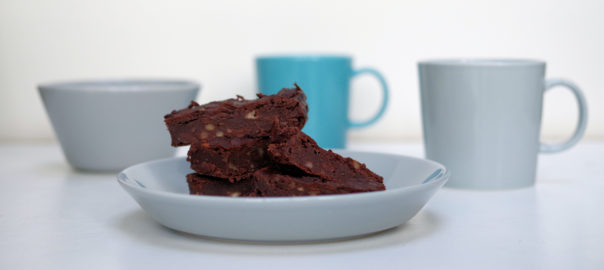
Picture of vegan brownies

Vegan chocolate brownie

Yoga Kitchen – Simple, healthy, and plant-based

Brownies without eggs or dairy products

Black beans are the secret protein source of this recipe. If you are working with dried black beans, soak them for 24 hours and then boil them soft. For this recipe, assume about 80 g of dry beans. Put the beans in a pan, cover with water and bring to the boil. Do not add salt to the cooking water.
Even better: use a pressure cooker, then they will be done in 25 minutes. In an ordinary saucepan, they need 45 to 60 minutes to cook. Add water now and again as it evaporates. But if you are a bit on the lazy side, you can also use canned black beans, which are soft, pre-cooked and ready to be eaten.

Why without eggs?

Who needs eggs? Eggs and egg powder are used abundantly in industrial pastry. Modern egg production is harmful and cruel to chickens, even if the eggs are supposedly from organic origin. Unless you care for your own chickens and entitle them to a dignified old age once they have stopped laying eggs, there are plenty of healthier and cheaper alternatives:

  • Like a simple banana.
  • Or apple sauce
  • Or a tablespoon of crushed flaxseed that you soak in two tablespoons of water.

The absence of eggs in this recipe means you can lick the leftover batter off your scraper without feeling guilty. There is no risk of salmonella infection, which can occur when you eat raw eggs.

With or without gluten?

You can also use a gluten-free type of flour in this recipe. Gluten-free flours such as millet, buckwheat, corn or soy are easier to digest for most of us. But you can also use a five-grain mix or whole-wheat spelt flour for a classic version with gluten. Many of today’s nutritionists say that modern, industrial wheat is best avoided. As far as pesticides are concerned, I agree with them. Personally, I think it is best to listen to your body’s reactions. Good wheat or spelt of organic origin (i.e. without pesticides) is OK in itself. Those grains also contain a lot of vegetable protein of good quality.

What you need for a small cake (approx. 350g):

  • One large, ripe banana. The riper, the better
  • Aproximately 120g rinsed black beans, soft boiled or canned. Aduki beans are also very good
  • 3 tablespoons of neutral-tasting vegetable oil that can withstand heating, e.g. high oleic sunflower oil
  • 1 teaspoon of ground vanilla (optional)
  • 6 soft mazafati or medjoul dates
  • 4 leveled tablespoons unsweetened pure cocoa
  • 2 teaspoons of baking powder
  • 40 to 45 g flour (buckwheat or millet flour for the gluten-free version of this brownie)
  • a pinch of sea salt.
  • 1/2 cup (about 40 g) coarsely chopped walnuts (other nuts will do too)
  • 1/2 cup (about 60 g) vegan black chocolate drops (optional)

It is always a good idea to soak the nuts in water overnight. The nuts revive, the bitterness disappears and they taste like they have just been picked fresh from the tree. They are also much more digestible. Discard the soaking water and rinse the nuts well.

It is done in a jiffy, really:

Preheat the oven to 180°C/340°F.

  • Place the beans, oil, dates and banana in a food processor and mix well, first slowly and then at higher speed.
  • Add the vanilla and then the cocoa. Puree everything well. The result is a rather liquid, moist glossy dark brown mixture.
  • Mix together the dry ingredients: the flour, the baking powder and the pinch of salt.
  • In the food processor, gradually mix the dry ingredients into the wet mixture until the mixture becomes a little drier, but still creamy and moist.
  • Spoon the contents of your food processor into a mixing bowl.
  • Then add the chopped nuts and chocolate drops. Mix roughly.
  • Finally, transfer everything to a low rectangular, square or round cake tin or baking tray covered with kitchen paper.

Bake for about 25 to 30 minutes. The brownie tastes best when it is still slightly moist inside. (A larger cake needs to bake a little longer).
Enjoy! With healthy and respectful ingredients like these, chocolate cake becomes healthy food full of love for the whole planet!

Black Bean brownies / Approximate nutritional value per 100 g of product:

Energy Carbohydrates Sugars Fat Sat. fat Protein Fibre Salt
1098,40 kJ/262,35 kcal 34,12 g 14,56 g 13,55 g 2,60 g 7,21 g 7,44 0,09 g

Read more about plant-based nutrition and health:

Find more articles about nutrition, health and plant-based foods:

Read more about plant-based food

Read more about yoga and yoga classes in Schaerbeek:

Check out our yoga classes here:

View our full range of yoga classes

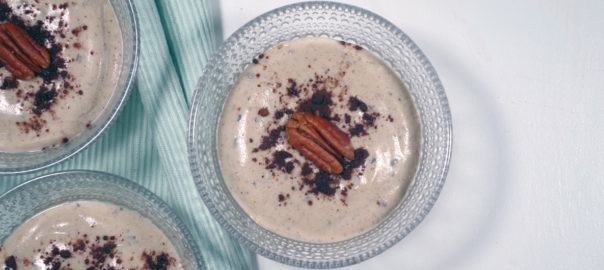
Picture of a dessert with silken tofu

Silken tofu delights

Yoga Kitchen – Simple, healthy, plant-based and compassionate.

Silken tofu as a basis for vegetable desserts.

When you eat healthy and plant-based, you leave out animal dairy products.
Sometimes that can seem like a daunting task.

That’s why it’s good to guard against the temptation of the gigantic and excessively large dairy departments in supermarkets, with all their overpackaged sweet cream and milk desserts.

Sadly, there is still relatively little plant-based dairy products and desserts in the trade. In the strategy to protect yourself, it is a good idea to make superior home-made versions yourself that you just have ready in your fridge. Things that are just as tasty and a lot healthier and which you can enjoy every day in moderation. By making them yourself, you know exactly what goes into them and you also save money and a huge mountain of packaging waste.
Here is an example of a very flexible basic recipe that you can vary in different flavour versions.

What do you need?

The basics

For the sweet silk tofu base you only need 2 to 3 ingredients:

  • 400 gr silken tofu
  • 6 to 7 large soft organic medjool or mazafati dates

And then there are the following options:

  • If you are an intensive athlete or if you want your dessert to be a bit more solid, then you may want to add 20 grams of pea protein.
  • If you just want it to be a bit firmer, without an extra protein boost, simply add a teaspoon of psyllium fibre.

The tastes

As for flavour, here are four different versions, each with its own flavour. But actually, there is no need to put a brake on your creativity.

For a chocolate version:

  • 2 tablespoons (raw) unsweetened cocoa

For a speculaas/allspice version:

  • 1 to 2 teaspoons of speculaas spices (or allspice mixture)
  • 1 extra teaspoon of cinnamon

For a hazelnut version (my favourite!):

  • 3 tablespoons organic unsweetened whole hazelnut butter

For a fruity version:

  • 30 g fruit such as mango (fresh or rehydrated dried mango) or fresh red fruit
  • some extra fruit to decorate

The toppings

To finish off, you can decorate the desserts with all kinds of tasty and healthy things such as:

  • walnuts or pecans
  • coarsely chopped raw cocoa beans
  • cinnamon powder
  • Some extra cocoa powder
  • Grated coconut
  • Extra fruit

Procedure:

This is really super easy.

  • Remove the seeds from the dates and cut them into pieces.
  • Do the silken tofu, dates, flavoring ingredients and possibly the pea protein in a food processor. Then grind everything until you have an even, fairly firm creamy texture.
  • Divide the result over 4 bowls.
  • Decorate with the elements of your choice.
  • Put in the refrigerator for a few hours to become firmer.

Bon appetit!

This dessert has deliberately been kept moderately sweet. We eat too much sugar anyway.
Do you find it not sweet enough? Then add 2 more dates, or a tablespoon of agave or maple syrup.

How is silken tofu made?

Silken tofu, like the firmer tofu, is made from soya beans. Its texture is a bit like a firm cottage cheese. Silken tofu is usually sold in 400 gram cartons.
Silken tofu consists of a large proportion of water and soya beans (approx. 20% – can vary somewhat from manufacturer to manufacturer) and contains around 5.3 g of high-quality protein per 100 g of product.
It also contains fat and carbohydrates in roughly equal proportions (approx. 2 g each). Silken tofu contains virtually neither sugars, nor salt.
It is very suitable for making desserts with a creamy texture.

Is silken tofu a good source of calcium?

.
Tofu can also be quite rich in calcium. It can … but not necessarily. It all depends on how the soya proteins are curdled. In order to curdle the proteins, a simple salt is used, which does not affect the taste. This salt is sold under the name of Nigari. It consists of:

  • either calcium chloride
  • or magnesium chloride

In the first case the end product (the silken tofu) will be rich in calcium, in the other case rich in magnesium.

Silken tofu / Nutritional value per 100 g product:

Energy Carbs Sugars Fat Sat. Fat Protein Fibre Salt
202 kJ/48 kcal 1.8 g <0.5 g 2.1 g 0.5 g 5.3 g <0,01 g

Read more about plant-based nutrition and health:

Read more articles about nutrition, health and plant-based foods:

Read more about plant-based food

Read more about yoga and yoga classes in Schaerbeek:

Check out our yoga classes here:

View our full range of yoga classes

Picture of aquakefir

Pamper your gut bacteria

Yoga Kitchen – Simple, healthy, plant-based, with compassion

Homemade aquakefir

Speaking of “influencers”: Your gut bacteria are undoubtedly the biggest influencers of your health.
Water kefir is a fermented drink with a pleasant tangy flavour. If you drink it in moderation, you’ll be supporting your gut bacteria. You can easily make it yourself. It’s very thirst-quenching and refreshing during the warmer months.

How do you make water kefir?

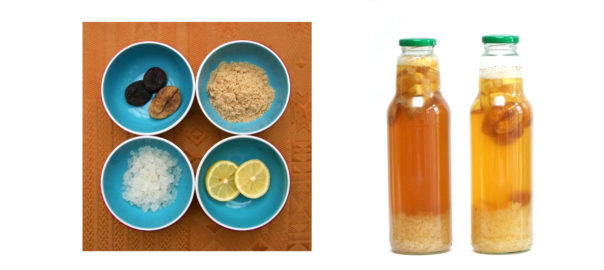
You make the drink by allowing sugar to ferment in water together with some dried fruit, slices of lemon and, most importantly: kefir grains.
These kefir grains are, in fact, microorganisms – a symbiosis between yeasts and beneficial bacteria. They look like small, white, semi-transparent, irregular little balls, a bit like tiny cauliflowers.
The fermentation process takes place in two stages:

  1. The first fermentation is essential. In a glass bottle or container, the kefir cultures are combined with water, cane sugar, a few slices of lemon and a piece of dried fruit. After about 48 hours, the kefir is ready.
  2. However, the second fermentation is optional. If you want to add colour and a fruity aroma to your kefir, leave it to ferment for a further 48 hours or so without the kefir cultures, adding pieces of fresh fruit of your choice.

Here are the practical steps to making your own aquakefir:

The ingredients

For 1 litre of water kefir:

  • 1 litre of water
  • 70 g light or dark cane sugar (avoid refined white sugar; whole sugar is better as it still contains numerous minerals)
  • 70 g aqua kefir cultures
  • Some dried fruit of your choice, such as apricots, figs, raisins or prunes …
  • A few slices of lemon, cut into pieces
  • An empty one-litre bottle with a screw-top lid or a sufficiently large preserving jar

If you use recycled 750 ml bottles, such as some commercially available organic fruit juice bottles, the amount of water becomes 750 ml and the corresponding amounts of sugar and cultures are 50 g each.
Choose organic-quality dried fruit, and in any case unsulphured. The same applies to the fresh lemon.

Preparation

First stage: fermentation

  1. Fill the one-litre bottle three-quarters full with water.
  2. Add the sugar to the water.
  3. Seal the bottle and shake to dissolve the sugar completely.
  4. Then weigh out the correct amount of kefir grains and add them to the bottle.
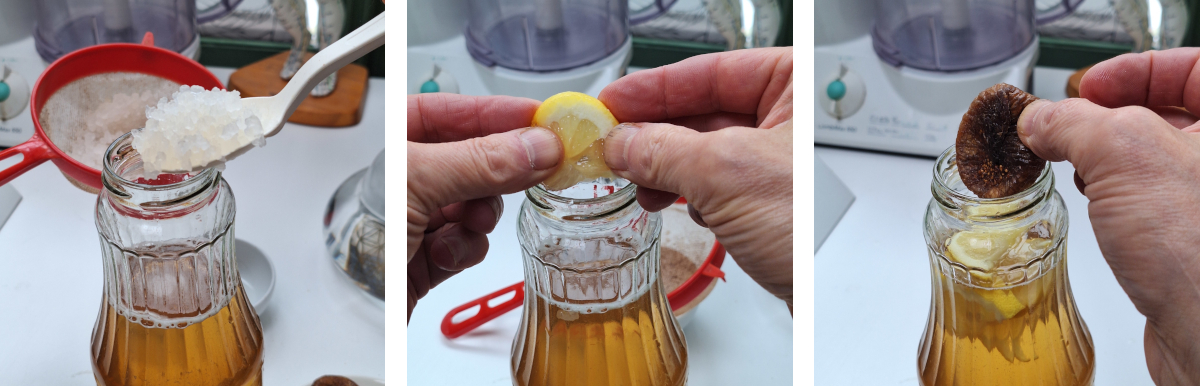
  5. Next, add dried fruit and half-slices of lemon. Squeeze the lemon gently to release the juice.
  6. Top up the bottle with water until it is almost full.
  7. Place the lid on the bottle, but do not screw it on tightly.
  8. Leave the bottle in a dark place at room temperature for 24 to 48 hours.
  9. Separate the drink from the cultures and fruit residues using a nylon sieve.

Your water kefir is now ready to use.
Picture showing steps in the making of aquakefir
Second stage: adding flavour with fresh fruit (optional)
Would you like a fruitier flavour?

  1. Chop some fresh fruit of your choice into pieces.
  2. Add them to your bottle of finished aquakefir, leaving out the kefir grains.
  3. Leave the bottle to stand for a further 24 to 48 hours at room temperature. Taste it from time to time
  4. Finally, strain through a sieve to remove the fruit bits.

Be creative with your choice of fruit. Cherries, strawberries, other red fruits, citrus fruits or fresh plums and apricots give excellent results.
Aquakefir keeps for a very long time in the fridge when stored in tightly sealed bottles with screw-top lids.

Important tips and instructions for the first fermentation:

  • It is strongly advised against handling or storing kefir grains with metal kitchen utensils. This would damage the kefir cultures. To be on the safe side, use fine-mesh nylon sieves and plastic, glass, ceramic or wooden spoons instead.
  • Use bottles with a wide opening of approx. 5 cm. These are easier to clean and maintain than bottles with a narrow neck.
  • Do not screw the lid on tightly as fermentation involves the formation of CO₂ bubbles which need to be able to escape. Otherwise, the bottle could theoretically explode due to the build-up of pressure.
  • The fermentation process gets underway quite quickly. Bubbles form and rise to the surface, the sugar content drops (after all, that is the ‘fuel’ for the cultures), the flavour becomes more acidic and the microorganisms grow.
  • If you ‘harvest’ the drink after just 24 hours, it may have mild laxative properties.
    Harvest after 48 hours for the best results.
  • If in doubt, taste it and stop the fermentation when you think the flavour is just right. The duration is also affected by the ambient temperature.
  • The citrus oil in the lemon peel contributes to the slightly sour-bitter flavour.

Where can I get the cultures?

I often get the kefir grains from other fermenters. You can also buy dried starter cultures in powder form from organic shops. In that case, follow the instructions on the sachets.

How do I maintain my kefir cultures if I don’t want to make kefir?

You can repeat the fermentation cycle as often and for as long as you like. You can give any surplus cultures to other people looking for aqua-kefir cultures, or simply dispose of them with your organic waste (in the orange bag or bin in Brussels, for example) or add them to your compost heap.
And if you’ve had enough for a while and need a break, you can store the cultures in a jar of water in the fridge with a teaspoon of sugar to keep them alive. This way, the cultures will remain in good condition in the fridge for three weeks. After three weeks, discard the water and rinse the cultures under running water. Add fresh water and a coffee spoonful of sugar, and you can store them in the same way for another three weeks.
Always rinse your kitchen utensils and cultures under running water after each use. Avoid harsh cleaning products or dishwasher detergents.

Does water kefir contain vitamin B12 or not?

According to certain sources, this drink contains vitamin B12. That seems quite possible to me, as there are other micro-organisms capable of producing vitamin B12. However, I have not yet seen any scientific confirmation for water kefir. So do not rely on this assumption to meet your vitamin B12 requirements.
If you’re vegan, or over 55, it’s definitely advisable to take a vitamin B12 supplement. After all, the body’s ability to absorb vitamin B12 decreases as we get older. By taking a well-dosed supplement regularly, you can be sure of a consistent, reliable and sufficiently high intake.

What’s the difference with kombucha?

Kombucha is related to water kefir. However, kombucha uses tea with sugar for fermentation. It also involves different microorganisms responsible for the fermentation. Read the article about kombucha here:

Homemade kombucha

How can I support my gut flora?

When your gut bacteria are thriving, you’ll be glowing with health. So they can do with all the support they can get. Fibre is essential for healthy gut flora.
A healthy, varied, unprocessed and predominantly plant-based diet with sufficient fibre is the most important thing. In addition, you can occasionally give the diversity of your gut flora a boost with probiotics. These are substances that provide extra beneficial bacteria and all sorts of secondary compounds that promote health. But probiotics are by no means a substitute for a healthy, balanced diet!

How much fermented food can I eat?

Fermented products such as sauerkraut, kimchi, kombucha and this aqua kefir are not staple foods. Include them as a tasty and healthy treat for your gut flora as part of an otherwise balanced diet.
Fermented foods such as yoghurts and fermented vegetables are most beneficial provided they are still ‘living’. This means they must not be pasteurised or sterilised.
Enjoy fermented products regularly, but in moderation.

Take part in the cooking workshops:

View the range of cooking workshops:

Cooking workshops

Read more about plant-based nutrition and health:

Read more about plant-based eating

Read more about yoga and yoga classes in Schaarbeek:

View our yoga classes here:

View the full range of yoga classes

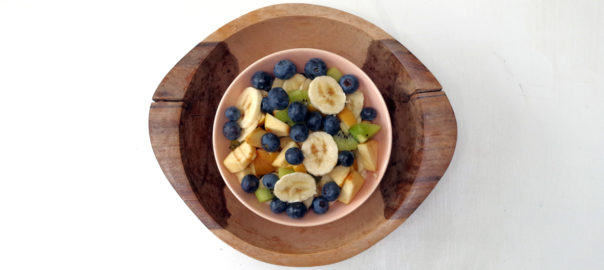
A mixed fruit salad

Fresh fruit in moderation

Optimize your fruit consumption

There was a time when I ate fresh fruit almost non-stop, all day long, whenever I felt “hungry” for something.
Not coincidentally, this was also the period when I suffered from very irregular digestion and bowel movements.
Is fruit healthy? Yes, undeniably. It is rich in vitamins, minerals, fibre and antioxidants.
The average western citizen probably doesn’t eat enough fresh fruit in general.
But there are a number of conditions for fully enjoying those gifts of fruit.
Fruit is not a miracle cure for weight or health problems.

What are the best moments to enjoy fruit?

Fruit is rich in sugars and also contains fructose, a sugar molecule the body has a hard time digesting as it seems.

Fruit is relatively rare in nature compared to vegetables, so it is best to eat in moderation. It is mainly available in nature at the end of summer and the beginning of autumn. In Mediterranean, subtropical and tropical areas, fruit is more abundantly available, but still always seasonal.

Here are three golden rules and a few more tips:

  • Eat fruit separately from other meals. Allow at least 30 minutes or an hour break. If you do eat fruit with other food, or immediately afterwards, it can lead to all sorts of nasty fermentation processes and gas.
  • The best times: at breakfast and in the late afternoon as a snack. Do not eat fruit late at night before bedtime.
  • Preferably eat fresh, local, organic and seasonal fruit.

How can I improve my digestion of fruit?

  • Do you have difficulty digesting raw fruit? Boil or fry it gently and add some spices, such as cinnamon, aniseed, nutmeg or even a pinch of black pepper. Warm apple, pear, banana or berries are delicious!
  • Drink (fresh) fruit juice sparsely. It is better to consume the whole fruit, including the fibres. Industrial “fruit juice” and fruit drinks or so-called nectars have a very low nutritional value and the cheaper types often have loads of extra sugar added.
  • The combination of fruit with milk products is absolutely not done. It is also better not to eat fruit with cereals (for example: avoid mixing fresh fruit in muesli).
  • Melons are best eaten separately, not even in combination with other fruit.
In mainstream health belief, fruit enjoys an exaggerated status. It is wrongly regarded as an easy way to lose weight. But in reality, you can easily get fat on fruit.
It contains very little protein and very little fat. So fruit is absolutely not a full-fledged nutrition source in itself.
Ceramics: @iittala

Read more about plant-based nutrition and health:

Read more articles about nutrition, health and plant-based foods:

Read more about plant-based food

Read more about yoga and yoga classes in Schaerbeek:

Check out our yoga classes here:

View our full range of yoga classes

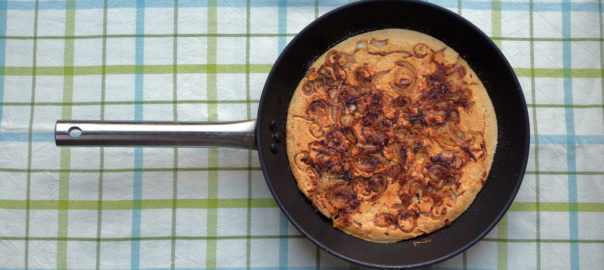
Picture of a vegan omelette

Vegan omelette with onions

Yoga Kitchen – Simple, healthy and vegan

Twenty-one grams of protein. That’s what one portion of this Italian-inspired vegetable omelette represents. Super easy to make and oh so tasty.

And there is not one egg involved. Why I don’t use eggs anymore you can read at the bottom of this article. By the way, it is so easy to either omit eggs or to substitute them in a natural and very qualitative way in culinary preparations.

For a rich omelette for two people:

For the filling:

  • 3 red (or yellow) onions
  • equally 3 shallots
  • and 3 large cloves of garlic
  • 2 tablespoons of olive oil
  • ¼ teaspoon of nutmeg
  • Some black pepper and sea or himalayan pink salt
  • 1 tablespoon balsamic vinegar

For the vegan “egg batter”:

  • 140 gram chickpea flour
  • approximately 350 ml water
  • 3 tablespoons nutritional yeast flakes
  • 1 teaspoon of sea salt or himalayan pink salt

A large frying pan, preferably with a non-stick coating, and a lid that fits.

How to proceed:

Preparing the filling

  • Place the 4 ingredients for the batter in a large bowl and batter with a garden.
    Make sure that the mixture has the consistency of pancake batter.
  • Heat the olive oil in the frying pan.
  • Fry the onions, shallots, garlic and nutmeg in the olive oil until they turn glassy and light brown. In culinary terms, this is called “caramelisation”.
  • Stir regularly.
  • At the end, add the balsamic vinegar, mix and remove the vegetables from the pan.

Finishing the omelette

  • Rinse the pan briefly, add another splash of olive oil.
  • Return the pre-fried onions to the pan, spread them evenly.
  • Pour the batter over the top, turn the heat down low and continue cooking for about 10 minutes. The top side of the omelette should have dried.
  • Turn the omelette (like a pancake, with a virtuoso somersault!) and bake for about 5 minutes more.

Tips and sources

All over the world, the so-called “poor man’s kitchens”, the traditional recipes of the simple folk, are real treasure chests of vegan recipes and common sense. Meat and fish were only for rich people. Another example from the Italian vegetable folk cuisine is polenta.

In traditional recipes, the technique of caramelisation is often used. I really recommend doing this gently and not go beyond light brown. Although extra virgin olive oil is considered one of the healthiest cooking oils, it should not be heated above 160 °C. In general, the best cooking techniques for our health are the gentle ones.

The recipe is one of the many delicious and easy recipes from the book “Veganista”, by Antwerp-based Luna Trapani, written in dutch language. She masterfully demonstrates how easily Italian cuisine can be “veganised”. Highly recommended, just like her second book: “Vegetalia”.

Born as a chicken in the 21st century

At the beginning of the twentieth century, a chicken laid an average of 20 eggs a year. Apart from that, she could happily scavenge through life, in the open air.
Today, the twenty-first century offspring of those belle époque chickens are locked up together by the tens of thousands in the unhealthy, stressful environment of closed hangars where the lights never go out. And A suffocating ammonia smell takes your breath away … they are now so genetically manipulated that their frail little bodies have to squeeze out an egg full of precious minerals and proteins every single day … not to mention the permanent doses of antibiotics they are being administered to prevent them from succumbing prematurely to infectious diseases, bacterial or viral. Why do people do this? Do we not learn from the pandemic of the coronavirus SARS-COVID ?

It is no longer possible to turn a blind eye or look away from these sad, immoral and violent practices. It borders on criminal neglect. That is what I think, at least.
Maybe you have a different opinion. So be it.

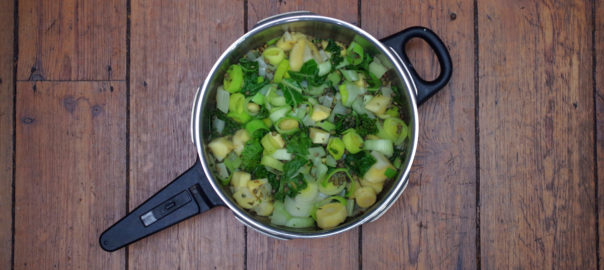
Pan with vegetables

Your daily soup

Eating plant-based begins with eating more plants – what’s in a name.
For many people, this is where the health of their diet is lacking.
Everyone has heard the message, once or even repeatedly, that for good health and strong immunity you should eat more vegetables. However, we come from traditions that gave vegetables a third-rate role by definition.

Plant Power

Fortunately, for more and more people, things are moving in the right direction!

An excellent way to drastically increase the amount of plant power in your diet is a daily soup.

A good soup is home-made, with fresh, organically grown vegetables, possibly with some legumes for more vegetable protein and a more solid texture.

Best ways

It is best to keep the cooking process as short as possible to preserve as much nutritional value as possible. Vitamins and enzymes break down in too much heat and too long a period of heat.

Good cooking processes for soup are :

– Cold raw soups
Raw vegetables are ground in a blender with herbs, possibly some nuts or sprouted legumes and cold water (e.g. summer soups such as gazpacho)

– Lukewarm raw soups
Raw vegetables are ground in a blender with herbs and possibly nuts or sprouted legumes with the addition of hot water, i.e. without boiling the soup. The result is a soup that barely exceeds 40°C.

– Classic hot soups prepared in a pressure cooker with a short cooking time (10 min. under steam)
Raw vegetables are cooked with herbs and pre-soaked and rinsed legumes such as lentils and beans in water under increased pressure. After steaming for ten minutes, the soup is ready and can be mixed.

If necessary, add vegetable stock to season.
Sea salt or miso is fine as a means of salting.

Enjoy !

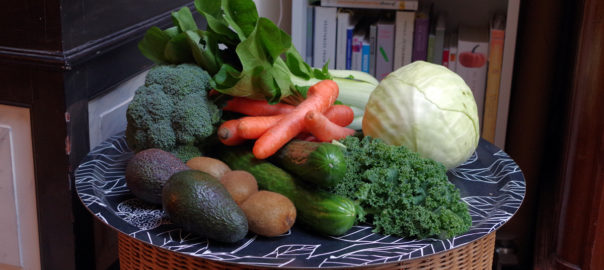
Picture of magnificent vegetables

Vegetables first

What are your fillers?

Feeling stuffed quickly

Virtually all conditions of obesity, lack of energy or digestive problems are caused by a wrong choice of food products.
In general, everyone has one or more products that are used as “fillers”.
A filler is a food that is relatively easy to prepare, which quickly gives a “full feeling” when eating. After all, an empty stomach is quickly misinterpreted as hunger. However, having an empty stomach is no sign at all that your body is hungry at that moment.
In our society, the fillers are often bread, pasta, white potatoes or rice.

Low quality fuel

Consequently, meals are still traditionally composed on the basis of such a filler. A plate is often filled with potatoes or pasta, and then topped off with sauce, a limited amount of vegetables and a protein source. Think of something like spaghetti bolognaise, a sandwich this or that or french fries with xyz.
The problem is that these common filling products are very poor in real nutrients, such as vitamins and minerals. You can think of them as a form of low-quality fuel.
In fact, you can stuff yourself until you almost pass out into a food coma, and still your body is waiting in vain for real nutrients. This is one of the reasons why (real) hunger quickly rears its head again, which you might smother with the same fillers. And so the cycle continues.

Systematically inflated profile

Here you have the recipe for the fastest-growing phenomenon in the world of health. More and more overweight people with a lack of energy. Paradoxically enough, obesity is in most cases not the result of overnutrition but of systematic malnutrition. The body does not know what to do with all that nutrient-poor, calorie-rich food. It converts the excess into fat and/or water. The body has too many acid-forming toxins to process. And to remove them from the bloodstream in time, there are only two solutions. Store them either in fatty tissue or in extra water pushed between the body cells. And there we have the recipe for the systematically inflated profile of most Belgians and Europeans today. We learned it from the Americans, and it is now quickly making school in Asia.

Healthy eating style

The lesson is simple: build every meal around a large amount of vegetables. Prefer green (leafy) vegetables, cabbages and coloured vegetables supplemented with root vegetables according to the season. Preferably strive for a nice balance between raw and lightly steamed. Vegetables are typically low in calories, but score very high in nutrients.
It’s a bit of a godsend, but the adage proclaimed for decades that “eat more vegetables” is not a free option. It is no more or no less than the single foundation of a healthy eating style. Without that foundation, the house of your health slowly collapses over the years.

Prosperity and ignorance

We are not exactly helped either. We are subject to traditions and habits about eating and cooking, handed down from mother to daughter. Our typical Belgian plate of today is the direct heir to the eating practices that have taken off since industrialisation. The standard diet of the working class person was cheap, “empty” filler food. Like the almost archetypal brown bread and the daily “cooked potatoes with sauce”. And if one was lucky on Sunday, a piece of cheap meat of the worst kind. The rich indulged in refined flour products and large quantities of meat. Vegetables played a totally secondary role in either case.

Diseases of affluence: really ?

And on the sidelines, the food industry, with its refined technologies and social marketing and engineering strategies, is aiming for one thing only: to make you buy and eat even more than is healthy for you.
There is no such thing as “diseases of affluence”. This term makes it seem as if you have to take it or leave it: either you have prosperity and you have to take disease with it as part of the deal, or you have no prosperity. What comes closer to the truth is “diseases of ignorance”. Or “profit driven-lack of legislation-lobbying diseases”.

Create your menus around the vegetables
So from today, reorganize your plate wisely and start eating a large quantity of varied vegetables of the season at every meal.

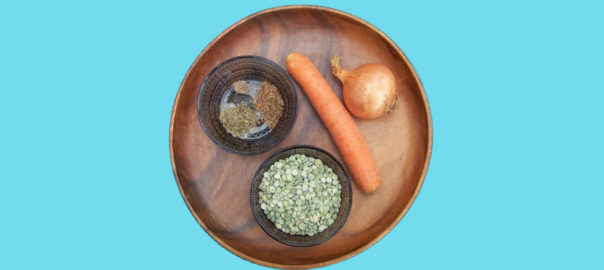
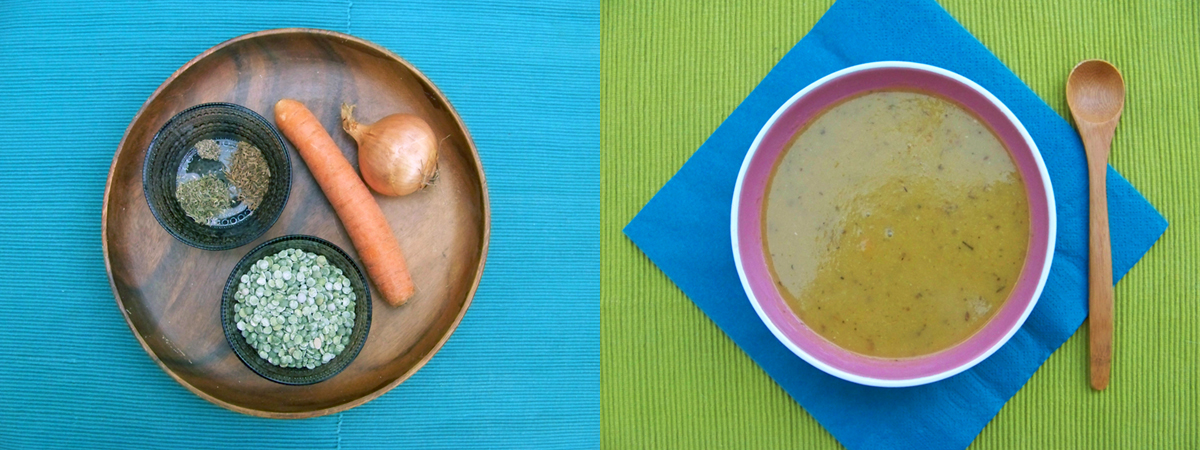
Split pea soup ingredients

Easy split pea soup

Yoga Kitchen – Simple, healthy and vegan

Anyone on a purely vegan diet would do well to keep a close eye on the proportion of protein. Peas and split peas are an excellent and very cheap source of high-quality plant protein with a rich and varied amino acid spectrum. They also contain a lot of complex carbohydrates and a good deal of valuable fibre.
Dream food, really!
What could be cozier and heartier than a good bowl of steaming hot pea soup in the cold season? And you can do that right from breakfast!

What you need for about 1 litre of freshly made soup:

  • 150 gr split peas
  • 1 carrot
  • 1 onion
  • eventually a piece of green celery
  • one to one and a half tablespoons of good olive oil
  • Herbs such as: cumin seed, savory, fennel seed …
  • pepper and salt to taste

You can also add vegetable stock cubes to give extra flavour to the soup, but I’m not a fan of that myself.
Picture of split pea soup with its ingredients

Step by step

  • Allow the split peas to soak in water for a few hours until they are swollen
  • Rinse them in a sieve under running water
  • Gently heat the olive oil on low fire, sprinkle in the herbs (cumin seed, savory, fennel, or others, according to personal taste …) and let them fry softly in the oil for a few moments allow them to release their flavour
  • Add the finely chopped onion and carrot and fry until they become a little glassy
  • Pour in the split peas, stir and briefly fry
  • Pour 1 litre of water over the vegetables, bring to the boil
  • The cooking time depends on the type of pan: approx. 35 minutes in an ordinary pan. If you use a pressure cooker, reduce the cooking time to about 15 to 20 minutes.

Extremely important

When cooking legumes, add the salt only after the cooking process.
This applies to sea salt, salted soy sauce as well as any salty stock cubes or stock in powder.
Finally, you might add some extra pepper to taste and finely mix the soup with a handheld mixer or in a blender.
Serve nice and hot!

Enjoy this delicious, simple, fortifying soup with its respectable protein content!
Nutritional values split peas

When is the best moment to eat protein?

Opinions differ.
Some people claim that you benefit more from protein in the morning and at noon than in the evening. They claim it would be best to go to bed “light” with a digestive system that has finished its day job so that all the energy can be put into recuperation at night.
On the other hand, the night is precisely the time when protein synthesis and muscle recovery and building also take place. So according to other authors, it is a good idea to include protein in your last meal so that it enters the bloodstream at night and is available for protein synthesis.
That seems to make good sense.