
Extreme heat calls for adjustments
This summer in Europe, we are once again experiencing first-hand that climate change is a reality and is accelerating at an ever-faster pace.
This has consequences for yoga practice and for everyone who teaches yoga.
Increasingly frequent and prolonged heatwaves are making us pay the price for decades of ill-considered energy production and consumption.
We cannot solve this in the short term.
We are facing unusual weather phenomena, with more extremes. This takes us out of our comfort zone and forces us to adapt and deal with the situation creatively. What seems extreme today may well be the new normal tomorrow.
But it takes some getting used to. After all, the temperatures we experience as extreme in Belgium are an everyday occurrence in so many other countries. And people practice yoga there too.
How do we adapt our yoga practice in extreme heat?
A few tips regarding the content of yoga classes:
- Prefer the early, fresher hours of the day for your own yoga practice at home
- Reduce the physical intensity of the yoga classes and do fewer poses and movements that tend to raise body temperature. In particular, poses that require the activation of (many) leg muscles.
- Reduce the duration of inverted poses or simply omit them. For example, stay in Downward-Facing Dog (Adho Mukha Svanasana) for no more than one breath
- Incorporate relatively more poses done lying down or sitting on the floor. After all, it’s cooler there. Warm air rises, cold air sinks.
- Encourage participants to pause regularly between poses and take a few calm breaths in and out before moving on to the next pose. This can be done whilst standing or in a resting pose such as the forward-folding hero pose or child’s pose.
- Make your yoga class a little more Yin and a little less Yang in terms of energy.
How do we prepare for a yoga class in high temperatures?
- Make sure you’re well hydrated before you start your class.
- Keep a bottle or glass of water within easy reach so you can take a sip during the class. Be aware that, in other circumstances, drinking during a class can also be a way of ‘escaping’ from the experience.
- Bring a small towel to wipe away sweat.
- Wear light clothing made from breathable fabrics.
What can you do about the layout of the room?
- Provide participants in your class with accurate information in advance about the conditions in the room (for example, the temperature) and any adjustments to the class content, so that they can assess for themselves whether participation is advisable or not. Sensitivity to heat varies greatly from person to person and increases with age.
- Ensure adequate air circulation using a few good fans. Ceiling fans have somewhat unfairly fallen out of favour.
- Black out windows and skylights during the hottest hours of the day to keep the temperature in the room as low as possible.
- Make sure participants can have a drink of water during the class and, if appropriate, provide a refreshing drink afterwards instead of the usual warm herbal tea.
- If necessary, provide extra towels for sweating.
- Have a few water spray bottles ready so that participants can moisten their faces if needed.
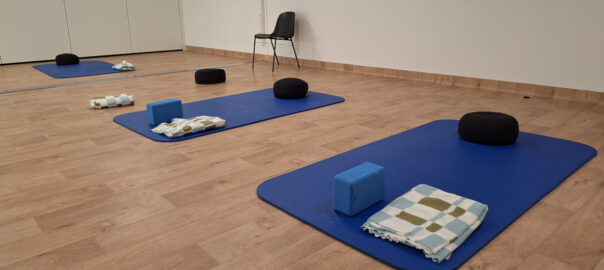
- Avoid red objects; opt for objects and accessories in cool, bluish or black tones, which simply have a visually cooling effect on the body and mind. Where possible, deliberately use blue, blue-green or other cool tones for the lighting instead of red and orange tones. For example, deliberately leave the Himalayan salt lamps switched off for a change.