All posts by petersan

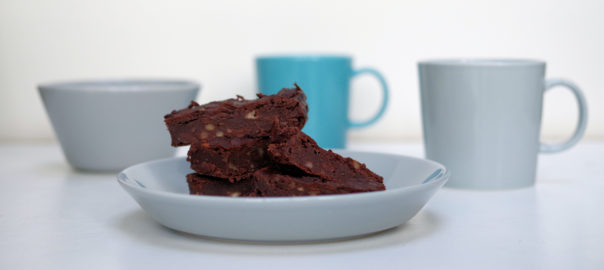
Picture of vegan brownies

Vegan chocolate brownie

Yoga Kitchen – Simple, healthy, and plant-based

Brownies without eggs or dairy products

Black beans are the secret protein source of this recipe. If you are working with dried black beans, soak them for 24 hours and then boil them soft. For this recipe, assume about 80 g of dry beans. Put the beans in a pan, cover with water and bring to the boil. Do not add salt to the cooking water.
Even better: use a pressure cooker, then they will be done in 25 minutes. In an ordinary saucepan, they need 45 to 60 minutes to cook. Add water now and again as it evaporates. But if you are a bit on the lazy side, you can also use canned black beans, which are soft, pre-cooked and ready to be eaten.

Why without eggs?

Who needs eggs? Eggs and egg powder are used abundantly in industrial pastry. Modern egg production is harmful and cruel to chickens, even if the eggs are supposedly from organic origin. Unless you care for your own chickens and entitle them to a dignified old age once they have stopped laying eggs, there are plenty of healthier and cheaper alternatives:

  • Like a simple banana.
  • Or apple sauce
  • Or a tablespoon of crushed flaxseed that you soak in two tablespoons of water.

The absence of eggs in this recipe means you can lick the leftover batter off your scraper without feeling guilty. There is no risk of salmonella infection, which can occur when you eat raw eggs.

With or without gluten?

You can also use a gluten-free type of flour in this recipe. Gluten-free flours such as millet, buckwheat, corn or soy are easier to digest for most of us. But you can also use a five-grain mix or whole-wheat spelt flour for a classic version with gluten. Many of today’s nutritionists say that modern, industrial wheat is best avoided. As far as pesticides are concerned, I agree with them. Personally, I think it is best to listen to your body’s reactions. Good wheat or spelt of organic origin (i.e. without pesticides) is OK in itself. Those grains also contain a lot of vegetable protein of good quality.

What you need for a small cake (approx. 350g):

  • One large, ripe banana. The riper, the better
  • Aproximately 120g rinsed black beans, soft boiled or canned. Aduki beans are also very good
  • 3 tablespoons of neutral-tasting vegetable oil that can withstand heating, e.g. high oleic sunflower oil
  • 1 teaspoon of ground vanilla (optional)
  • 6 soft mazafati or medjoul dates
  • 4 leveled tablespoons unsweetened pure cocoa
  • 2 teaspoons of baking powder
  • 40 to 45 g flour (buckwheat or millet flour for the gluten-free version of this brownie)
  • a pinch of sea salt.
  • 1/2 cup (about 40 g) coarsely chopped walnuts (other nuts will do too)
  • 1/2 cup (about 60 g) vegan black chocolate drops (optional)

It is always a good idea to soak the nuts in water overnight. The nuts revive, the bitterness disappears and they taste like they have just been picked fresh from the tree. They are also much more digestible. Discard the soaking water and rinse the nuts well.

It is done in a jiffy, really:

Preheat the oven to 180°C/340°F.

  • Place the beans, oil, dates and banana in a food processor and mix well, first slowly and then at higher speed.
  • Add the vanilla and then the cocoa. Puree everything well. The result is a rather liquid, moist glossy dark brown mixture.
  • Mix together the dry ingredients: the flour, the baking powder and the pinch of salt.
  • In the food processor, gradually mix the dry ingredients into the wet mixture until the mixture becomes a little drier, but still creamy and moist.
  • Spoon the contents of your food processor into a mixing bowl.
  • Then add the chopped nuts and chocolate drops. Mix roughly.
  • Finally, transfer everything to a low rectangular, square or round cake tin or baking tray covered with kitchen paper.

Bake for about 25 to 30 minutes. The brownie tastes best when it is still slightly moist inside. (A larger cake needs to bake a little longer).
Enjoy! With healthy and respectful ingredients like these, chocolate cake becomes healthy food full of love for the whole planet!

Black Bean brownies / Approximate nutritional value per 100 g of product:

Energy Carbohydrates Sugars Fat Sat. fat Protein Fibre Salt
1098,40 kJ/262,35 kcal 34,12 g 14,56 g 13,55 g 2,60 g 7,21 g 7,44 0,09 g

Read more about plant-based nutrition and health:

Find more articles about nutrition, health and plant-based foods:

Read more about plant-based food

Read more about yoga and yoga classes in Schaerbeek:

Check out our yoga classes here:
View our full range of yoga classes

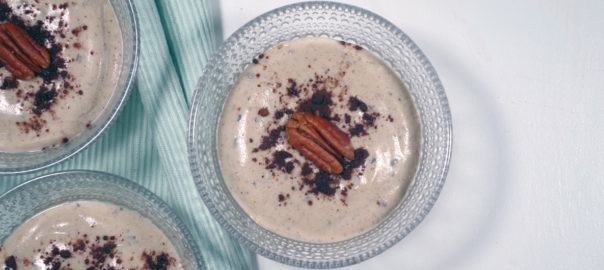
Picture of a dessert with silken tofu

Silken tofu delights

Yoga Kitchen – Simple, healthy, plant-based and compassionate.

Silken tofu as a basis for vegetable desserts.

When you eat healthy and plant-based, you leave out animal dairy products.
Sometimes that can seem like a daunting task.

That’s why it’s good to guard against the temptation of the gigantic and excessively large dairy departments in supermarkets, with all their overpackaged sweet cream and milk desserts.

Sadly, there is still relatively little plant-based dairy products and desserts in the trade. In the strategy to protect yourself, it is a good idea to make superior home-made versions yourself that you just have ready in your fridge. Things that are just as tasty and a lot healthier and which you can enjoy every day in moderation. By making them yourself, you know exactly what goes into them and you also save money and a huge mountain of packaging waste.
Here is an example of a very flexible basic recipe that you can vary in different flavour versions.

What do you need?

The basics

For the sweet silk tofu base you only need 2 to 3 ingredients:

  • 400 gr silken tofu
  • 6 to 7 large soft organic medjool or mazafati dates

And then there are the following options:

  • If you are an intensive athlete or if you want your dessert to be a bit more solid, then you may want to add 20 grams of pea protein.
  • If you just want it to be a bit firmer, without an extra protein boost, simply add a teaspoon of psyllium fibre.

The tastes

As for flavour, here are four different versions, each with its own flavour. But actually, there is no need to put a brake on your creativity.

For a chocolate version:

  • 2 tablespoons (raw) unsweetened cocoa

For a speculaas/allspice version:

  • 1 to 2 teaspoons of speculaas spices (or allspice mixture)
  • 1 extra teaspoon of cinnamon

For a hazelnut version (my favourite!):

  • 3 tablespoons organic unsweetened whole hazelnut butter

For a fruity version:

  • 30 g fruit such as mango (fresh or rehydrated dried mango) or fresh red fruit
  • some extra fruit to decorate

The toppings

To finish off, you can decorate the desserts with all kinds of tasty and healthy things such as:

  • walnuts or pecans
  • coarsely chopped raw cocoa beans
  • cinnamon powder
  • Some extra cocoa powder
  • Grated coconut
  • Extra fruit

Procedure:

This is really super easy.

  • Remove the seeds from the dates and cut them into pieces.
  • Do the silken tofu, dates, flavoring ingredients and possibly the pea protein in a food processor. Then grind everything until you have an even, fairly firm creamy texture.
  • Divide the result over 4 bowls.
  • Decorate with the elements of your choice.
  • Put in the refrigerator for a few hours to become firmer.

Bon appetit!

This dessert has deliberately been kept moderately sweet. We eat too much sugar anyway.
Do you find it not sweet enough? Then add 2 more dates, or a tablespoon of agave or maple syrup.

How is silken tofu made?

Silken tofu, like the firmer tofu, is made from soya beans. Its texture is a bit like a firm cottage cheese. Silken tofu is usually sold in 400 gram cartons.
Silken tofu consists of a large proportion of water and soya beans (approx. 20% – can vary somewhat from manufacturer to manufacturer) and contains around 5.3 g of high-quality protein per 100 g of product.
It also contains fat and carbohydrates in roughly equal proportions (approx. 2 g each). Silken tofu contains virtually neither sugars, nor salt.
It is very suitable for making desserts with a creamy texture.

Is silken tofu a good source of calcium?

.
Tofu can also be quite rich in calcium. It can … but not necessarily. It all depends on how the soya proteins are curdled. In order to curdle the proteins, a simple salt is used, which does not affect the taste. This salt is sold under the name of Nigari. It consists of:

  • either calcium chloride
  • or magnesium chloride

In the first case the end product (the silken tofu) will be rich in calcium, in the other case rich in magnesium.

Silken tofu / Nutritional value per 100 g product:

Energy Carbs Sugars Fat Sat. Fat Protein Fibre Salt
202 kJ/48 kcal 1.8 g <0.5 g 2.1 g 0.5 g 5.3 g <0,01 g

Read more about plant-based nutrition and health:

Read more articles about nutrition, health and plant-based foods:

Read more about plant-based food

Read more about yoga and yoga classes in Schaerbeek:

Check out our yoga classes here:
View our full range of yoga classes

Picture of aquakefir

Pamper your gut bacteria

Yoga Kitchen – Simple, healthy, plant-based, compassionate.

Speaking of “influencers”: your gut bacteria are certainly the biggest influencers of your health.
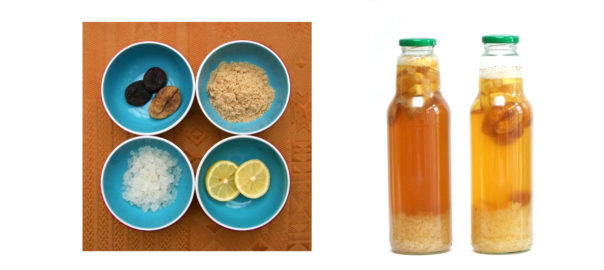
Water or aquakefir is a drink with a fresh pleasantly sour taste. Our intestinal bacteria love it. You make the drink by fermenting sugar in water together with some dried fruit, slices of lemon and above all: water kefir cultures.
These cultures are in fact microorganisms, a symbiosis between yeasts and benign bacteria, whose bodies look like small, white, semi-transparent irregular balls, a bit like tiny cauliflower heads.
This is a recipe for homemade aquakefir:

The ingredients

For 1 litre of water kefir:

  • 1 litre water
  • 70 gr light or dark cane sugar (avoid refined white sugar, a whole and unrefined sugar is better, it still contains numerous minerals)
  • 70 gr of aquakefir cultures
  • Some dried fruit of your choice, such as apricots, figs, sultanas or prunes …
  • A few slices of lemon, cut into pieces
  • One empty bottle of one litre with a screw-on lid or a sufficiently large preserving jar

If you use 750 ml reused bottles such as the commercial organic fruit juice bottles, the amount of water will be 750 ml and the corresponding amount of sugar and cultures 50 g each.
Choose dried fruit of organic quality, and in any case unsulphured. Idem for the fresh lemon.

Preparation

First stage: fermentation
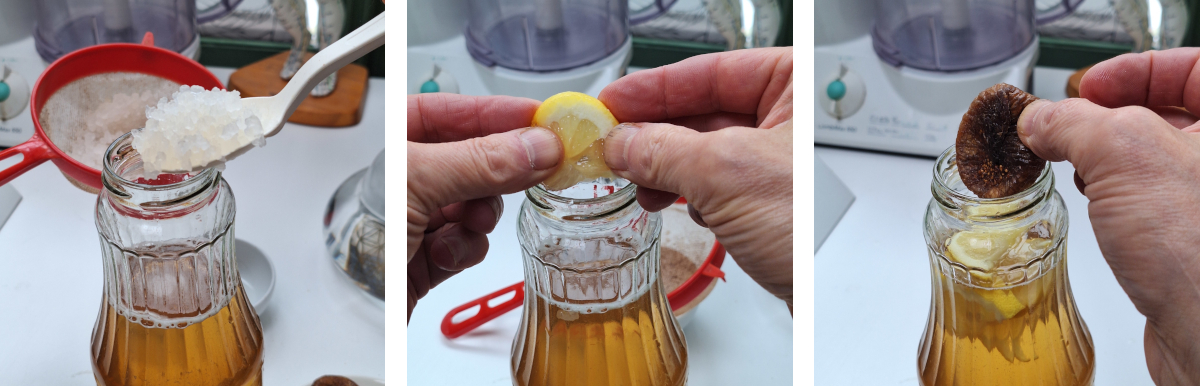
Add the sugar to the water, close the bottle, shake to dissolve the sugar completely.
Then weigh out the appropriate quantity of cultures and add them to the contents of the bottle. Next, add the dry fruits cut into pieces and the lemon. Squeeze the lemon lightly to release the juice.
Put the lid on the bottle, but do not screw it down. Fermentation causes the formation of CO2 bubbles which must be allowed to escape, otherwise the bottle could explode due to the pressure built up.
Leave the bottle at room temperature for 24 to 48 hours.
After a few hours, the fermentation process will get into full swing. Bubbles will form and float to the surface, the sugar content will drop (this is the “fuel” for the cultures) and the micro-organisms will grow.
If you “harvest” the drink after 24 hours, it will have slightly laxative properties.
Harvest after 48 hours for the best result.
Separate the drink from the cultures and fruit residues using a sieve.
Your water kefir is ready for use.

Second phase: adding flavour with fresh fruit (optional)
Would you like a fruitier flavour?
Cut up some fresh fruit of your choice and add it to your bottle of finished aquakefir. Leave the bottle at room temperature for another 24 hours, then filter through a sieve to separate out any fruit residue.
Be creative in your choice of fruit. Cherries, strawberries, citrus fruit or fresh plums or umeboshi plums give excellent results.
Aquakefir keeps for around ten days in the fridge.

Where to get the cultures?

I often get the kefir ‘flowers’ from other fermenters. You can also buy powdered starter cultures in organic shops. In that case, follow the instructions on the package.

Maintaining the cultures

Important: These beautiful creatures are allergic to metals it seems. So use utensils in plastic, wood, glass or ceramic to handle or filter them.
Use a fine-mesh nylon sieve. I do not recommend a sieve in metal or metal spoons.
You can repeat the fermentation cycle as often and as long as you like. You can distribute the surplus cultures to other people who are looking for aquakefir cultures or just compost them or throw them away.
And if you have had enough and need a break, you can keep the cultures in a jar of water in the fridge with a pinch of sugar as a survival ration. This way the cultures stay in good condition in the fridge for three weeks. After three weeks, throw away the water, rinse the cultures under running water and store them in the same way for another three weeks.
Always rinse your utensils and cultures under running water after each use. Avoid aggressive cleaning or dishwashing products.

Vitamin B12?

Some sources claim that this drink contains vitamin B12. This seems quite possible, as there are other micro-organisms that are able to produce vitamin B12. However, I have not yet seen any scientific confirmation for water kefir. So don’t build on this assumption!.
If you are a vegan, or if you are over 55, it is advisable to take a vitamin B12 supplement anyway. The absorption capacity of the body decreases with age. With regular intake of a supplement, you are assured of a regular, reliable and sufficiently high intake.

Gut flora

If your intestinal bacteria flourish, you radiate health. So they can use all the support they can get.
A healthy, varied diet with sufficient fibre is crucial. In addition, you can boost the diversity of your intestinal flora from time to time with probiotics. These are substances that provide additional favourable bacteria and all kinds of substances.

In moderation

Fermented foods such as sauerkraut, kimchee, kombucha and this aquakefir, are not a staple food. Add them as a tasty and healthy extra for your gut flora to an otherwise balanced diet.
Fermented foods such as yoghurts and fermented vegetables exert their beneficial effect on condition that they are still “alive”. This means that they must not be pasteurised or sterilised.
Use fermented products in moderation.

Image of the Fish posture

Open your heart with Fish posture

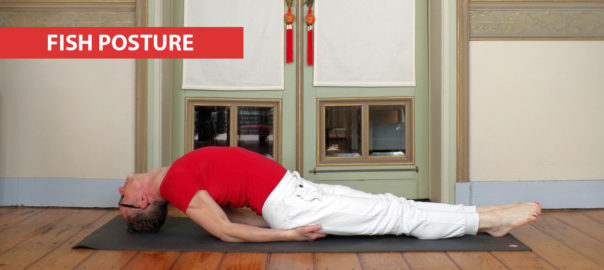
Our posture for the month of May is Fish Posture, or Matsyasana.
Excellent to practice right after candle and/or plough posture, as it helps to rebalance the neck.

See how this posture supports us on so many different levels:

Physical

  • Deepening of the breath
  • More space and release of tension around the heart
  • Strengthening of the upper back
  • Stimulation of the thyroid and thymus glands
  • Deep stretch of the neck and jaw muscles as well as the throat

Energetical

  • It improves the energy flow between solar plexus, heart- and throatchakra.
  • Stretching of the Ren Mai and Bladder meridian on the trunc
  • Stretching of the Stomach and Liver meridians in the legs (when performed with legs in tailor posture or lotus posture)

Emotional

  • Cultivation of Joy and Hope.
  • Counteracts depression and fearful reticence

Mental

  • Helps to bring on and keep a positive, optimistic and inspiring attitude to life

Spiritual

  • To engage with life with an open and trustful attitude
  • Courage
  • Hope
  • Love of Freedom
  • Selfless Love
  • Compassion
  • Kindness
  • Purity
  • Helps to develop the Heart chakra awareness.
Prana Yoga Flow and Prana Yoga on Monday, Tuesday and Wednesday.
Want to book one of our classes?
Check out the calendar via the button below:

Book your class

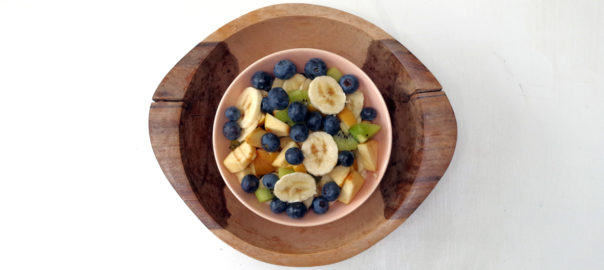
A mixed fruit salad

Fresh fruit in moderation

Optimize your fruit consumption

There was a time when I ate fresh fruit almost non-stop, all day long, whenever I felt “hungry” for something.
Not coincidentally, this was also the period when I suffered from very irregular digestion and bowel movements.
Is fruit healthy? Yes, undeniably. It is rich in vitamins, minerals, fibre and antioxidants.
The average western citizen probably doesn’t eat enough fresh fruit in general.
But there are a number of conditions for fully enjoying those gifts of fruit.
Fruit is not a miracle cure for weight or health problems.

What are the best moments to enjoy fruit?

Fruit is rich in sugars and also contains fructose, a sugar molecule the body has a hard time digesting as it seems.

Fruit is relatively rare in nature compared to vegetables, so it is best to eat in moderation. It is mainly available in nature at the end of summer and the beginning of autumn. In Mediterranean, subtropical and tropical areas, fruit is more abundantly available, but still always seasonal.

Here are three golden rules and a few more tips:

  • Eat fruit separately from other meals. Allow at least 30 minutes or an hour break. If you do eat fruit with other food, or immediately afterwards, it can lead to all sorts of nasty fermentation processes and gas.
  • The best times: at breakfast and in the late afternoon as a snack. Do not eat fruit late at night before bedtime.
  • Preferably eat fresh, local, organic and seasonal fruit.

How can I improve my digestion of fruit?

  • Do you have difficulty digesting raw fruit? Boil or fry it gently and add some spices, such as cinnamon, aniseed, nutmeg or even a pinch of black pepper. Warm apple, pear, banana or berries are delicious!
  • Drink (fresh) fruit juice sparsely. It is better to consume the whole fruit, including the fibres. Industrial “fruit juice” and fruit drinks or so-called nectars have a very low nutritional value and the cheaper types often have loads of extra sugar added.
  • The combination of fruit with milk products is absolutely not done. It is also better not to eat fruit with cereals (for example: avoid mixing fresh fruit in muesli).
  • Melons are best eaten separately, not even in combination with other fruit.
In mainstream health belief, fruit enjoys an exaggerated status. It is wrongly regarded as an easy way to lose weight. But in reality, you can easily get fat on fruit.
It contains very little protein and very little fat. So fruit is absolutely not a full-fledged nutrition source in itself.
Ceramics: @iittala

Read more about plant-based nutrition and health:

Read more articles about nutrition, health and plant-based foods:

Read more about plant-based food

Read more about yoga and yoga classes in Schaerbeek:

Check out our yoga classes here:
View our full range of yoga classes

Picture of a vegan omelette

Vegan omelette with onions

Yoga Kitchen – Simple, healthy and vegan

Twenty-one grams of protein. That’s what one portion of this Italian-inspired vegetable omelette represents. Super easy to make and oh so tasty.

And there is not one egg involved. Why I don’t use eggs anymore you can read at the bottom of this article. By the way, it is so easy to either omit eggs or to substitute them in a natural and very qualitative way in culinary preparations.

For a rich omelette for two people:

For the filling:

  • 3 red (or yellow) onions
  • equally 3 shallots
  • and 3 large cloves of garlic
  • 2 tablespoons of olive oil
  • ¼ teaspoon of nutmeg
  • Some black pepper and sea or himalayan pink salt
  • 1 tablespoon balsamic vinegar

For the vegan “egg batter”:

  • 140 gram chickpea flour
  • approximately 350 ml water
  • 3 tablespoons nutritional yeast flakes
  • 1 teaspoon of sea salt or himalayan pink salt

A large frying pan, preferably with a non-stick coating, and a lid that fits.

How to proceed:

Preparing the filling

  • Place the 4 ingredients for the batter in a large bowl and batter with a garden.
    Make sure that the mixture has the consistency of pancake batter.
  • Heat the olive oil in the frying pan.
  • Fry the onions, shallots, garlic and nutmeg in the olive oil until they turn glassy and light brown. In culinary terms, this is called “caramelisation”.
  • Stir regularly.
  • At the end, add the balsamic vinegar, mix and remove the vegetables from the pan.

Finishing the omelette

  • Rinse the pan briefly, add another splash of olive oil.
  • Return the pre-fried onions to the pan, spread them evenly.
  • Pour the batter over the top, turn the heat down low and continue cooking for about 10 minutes. The top side of the omelette should have dried.
  • Turn the omelette (like a pancake, with a virtuoso somersault!) and bake for about 5 minutes more.

Tips and sources

All over the world, the so-called “poor man’s kitchens”, the traditional recipes of the simple folk, are real treasure chests of vegan recipes and common sense. Meat and fish were only for rich people. Another example from the Italian vegetable folk cuisine is polenta.

In traditional recipes, the technique of caramelisation is often used. I really recommend doing this gently and not go beyond light brown. Although extra virgin olive oil is considered one of the healthiest cooking oils, it should not be heated above 160 °C. In general, the best cooking techniques for our health are the gentle ones.

The recipe is one of the many delicious and easy recipes from the book “Veganista”, by Antwerp-based Luna Trapani, written in dutch language. She masterfully demonstrates how easily Italian cuisine can be “veganised”. Highly recommended, just like her second book: “Vegetalia”.

Born as a chicken in the 21st century

At the beginning of the twentieth century, a chicken laid an average of 20 eggs a year. Apart from that, she could happily scavenge through life, in the open air.
Today, the twenty-first century offspring of those belle époque chickens are locked up together by the tens of thousands in the unhealthy, stressful environment of closed hangars where the lights never go out. And A suffocating ammonia smell takes your breath away … they are now so genetically manipulated that their frail little bodies have to squeeze out an egg full of precious minerals and proteins every single day … not to mention the permanent doses of antibiotics they are being administered to prevent them from succumbing prematurely to infectious diseases, bacterial or viral. Why do people do this? Do we not learn from the pandemic of the coronavirus SARS-COVID ?

It is no longer possible to turn a blind eye or look away from these sad, immoral and violent practices. It borders on criminal neglect. That is what I think, at least.
Maybe you have a different opinion. So be it.

Two legged table pose

Good care for your back

Our back, and more specifically our spine, is the central structure of our body that literally supports and sustains our entire body. If at some point the well-being of our back gets lost, it immediately has a major impact on the structure and coherence of our entire life. So it definitely pays off to give your back permanent attention. And this can be done on various levels.

Attention

First of all there is the attention. Bring your attention to your back regularly. Whether you do mental work in a predominantly sedentary job or mainly physical work, you will benefit from allowing your attention to "commute", to go back and forth between the object of your activities and your body, and more specifically your back. How does your back feel? How is your pelvis? What position is your lower back in? Do you have a slight hollow there or do the points of your lumbar vertebrae stick out because your lower back has sagged? And also: where does your head stand in relation to your torso? Is it nicely on top and in balance? Or does your head protrude systematically?

Breathing

Our breathing supports our back more than we might suspect. How is your breathing? Deep or very shallow and restricted? Do you breathe mainly upwards (thoracic breathing) or downwards (belly or abdominal breathing)? It is good to use your whole breathing space, your whole breathing capacity, and to breathe sufficiently upwards, towards the upper chest, shoulders and collarbones. This causes your chest to expand, the expansion and contraction in the rhythm of the breath brings life and movement to the body’s tissues. And this makes it less likely that energy will be trapped and the muscles will have less chance to cramp up and create “knots”. The expansion of the chest opens the body and gives full support to the whole back.

Sitting position

Especially for the large number of people who spend most of their days sitting, it is good to consider your sitting position on a chair. Prolonged sitting on chairs or sofas keeps the muscles in the back of the thigh short, whereas we would benefit from long, supple hamstrings. Moreover, the flow of blood is also slowed down. Sitting on a chair is also fatal for our pelvis. We gradually lose freedom of movement in our hip joint. In fact, sitting and living on the floor is one of the healthiest decisions you can make for your back and hips! Not evident in our Western culture, which collectively rejects contact with the earth.

Micro pauses

Going back and forth with your attention between activity and body can be combined well with micro-movements. These are all kinds of short movements, such as raising and lowering the shoulders, rolling the shoulders, twisting the upper body to the left and right from the waist, stretching the arms and laterally stretching the torso, which break the long, static sitting posture. You should also get up for a few minutes every half hour and take a walk.

Back strengthening

Finally, it is important to keep your back in top condition by regularly doing appropriate stretching and strengthening exercises. Our yoga for the back class is perfect for this. In yoga for the back, we combine attention, breathing and appropriate exertion and relaxation to leave back problems behind us for good. Whatever your condition or body type, our yoga for the back class will provide you with the keys to a full, conscious experience of the wonderful structure that is our back and to restoring and maintaining the wellbeing of your back. Yoga for the back on Friday evening from 19.00 to 20.00 in a small group of maximum 7 persons, the ideal preparation after a busy week to go totally relaxed into the weekend.
A quote from Rémi

How Rémi feels about it

1. What is your main reason or your main motivation to take yoga classes?

There’s that sporty side and the fact that you gain flexibility, there’s also the relaxation and the feeling of well-being after your classes.

2. What makes you feel motivated to keep taking the classes for so long?

I like continuity in human relationships and in my activities and your course is one of them.
I like to follow your classes and to meet up with other yoga friends and thus form a nice community.

3. Why do you take classes here at Yoga Kitchen, instead of going to another yoga studio?

Your professionalism, seriousness and gentleness.

4. What do you particularly like about the yoga classes / approach / atmosphere here at Yoga Kitchen?

I really like the atmosphere you create in your classes.

5. Are there perhaps any purely practical elements that make you choose the yoga classes here?

The opportunity to do your classes online which is more convenient since your studio is far from my home? I like the online option.
The fact that the class dates and times are precise and known in advance, it allows you to plan your week.
The flexibility of your card system.

Thank you very much for your answers, Rémi, and see you soon.

Peter

Quote from An

The revelation for An

1. What is your main reason or motivation for taking yoga classes?

The yoga is very relaxing for me, because of the breathing in combination with the movement.
It works quite meditative.
Twice a week I feel really relaxed after yoga. 
They make my weekly two hours with myself (-:

2. What makes you feel motivated to keep taking the classes for so long to this day?

I’ve become a bit addicted to it (while I used to think that yoga really wasn’t for me).
I miss it when I can’t take some classes.
It does not only does good in my mind, my body is also relaxed and I feel more flexible.
I also need the verbal guidance to do the series of postureses, I don’t think I could do it alone or have the discipline to do so.

3. Why do you take the classes here at Yoga Kitchen, instead of going to another yoga studio ?

I’ve never been anywhere else. I am satisfied (-:
Once I did 1 class of a very active yoga style, but it only hurt and they seemed like impossible postures to me.
With the Prana yoga I also found the first classes very difficult. Now I find the recurring sequence of movements easier to do and it’s also nice that things come back.

4. What do you particularly like about the yoga classes / approach / atmosphere here at Yoga Kitchen?

I really like the individual adjustments, and also the fact that you stop to think too much about things, consciously emptying your head etc.
The private session with you concerning my chronic hyperventilation proved very instructive. Because of this, I apply things more during the classes, but also outside of them.
I notice that in the live classes this is attention for the individual is even more important, with small adjustments for those who need something.
I appreciate that we are invited to learn to listen (consciously) to our own body.

5. Are there any perhaps purely practical elements that make you choose the yoga classes here?

For me it was during the COVID lockdown with the online classes of course that I started, also because I had more time available in my schedule then.
I love being able to do it from home, from my friend’s house or whilst on holiday.

A massive thank you for your answers, An, and see you soon!

Peter

A quote from Sanne

Sanne’s idea

1. What is your main reason or motivation for taking yoga classes?

For me, yoga is a way to get out of my head and stay physically flexible.

2. What makes you feel motivated to keep following the classes for so long until today?

I feel better when I practice yoga, I have less back pain and I am more relaxed.

3. Why do you take classes here at Yoga Kitchen, instead of going to another yoga studio?

.
It’s a nice location, close to my home, small scale, no big gym, pleasant atmosphere.

4. What do you particularly appreciate about the yoga classes / approach / atmosphere here at Yoga Kitchen?

I prefer the longer class of 1.5 hours. There is a good balance between relaxation and effort. The approach is individual, everyone does the exercises and postures in his/her own way.

Thank you very much for your feedback Sanne, and see you soon!

Peter